 Collectors
- Citizen Classic Corso Eco-Drive Chronograph (best overall) · See price on Amazon
- Citizen Thin Blue Line Eco-Drive Chronograph (best value) · See price on Amazon
- Bulova Archive Series Lunar Pilot Precisionist Chronograph (best premium) · See price on Amazon
Full reasoning, verified listing details, and a comparison table below.
Prices are shown on Amazon at click-through. We may earn a commission.
How We Picked
We required a live in-stock listing with no quantity warnings and a rating count deep enough to mean something, which in this category meant hundreds rather than dozens. We weighted movement type, water resistance, and crystal material, because those three decide whether a chronograph survives being owned. Two of our three picks are Citizen. We also left out a Bulova Marine Star chronograph with 1,297 ratings, in stock and rated 4.8 - a genuinely close call, and we want to be straight that it was not left out for being worse. It is a rose-gold dress chronograph, and taking it would have meant dropping either the water-resistant pick or the premium one and running two Bulovas. We chose a spread of price and purpose over a spread of rating counts; a reasonable person could pick differently. If you want to understand the complication before buying it, read what a chronograph actually is first; our Eco-Drive roundup covers non-chronograph Citizens with no ASIN overlap.
1. Best Overall: Citizen Classic Corso Eco-Drive Chronograph

Citizen Classic Corso Eco-Drive Chronograph
Citizen
- Eco-Drive - light-powered, so no routine battery replacement
- Sapphire crystal, stated in the listing title
- Chronograph with 12/24 hour time and date
- Reference AT2141-52L
- Several variants listed, all above our price floor at the prices we saw
- 4.7 stars from 2,760 ratings - one of the deepest rating counts anywhere on this site
Why we picked it: Two thousand seven hundred ratings at 4.7 stars is the kind of record that makes a recommendation easy. The specification is the other reason: sapphire crystal rather than mineral glass, which is in our view the most useful upgrade a watch at this money can carry, and Eco-Drive, which means the watch charges from light rather than needing a battery fitted every few years. One gap worth naming precisely: the full listing title states the movement, the crystal, the 12/24-hour display and the date, and says nothing at all about water resistance. Our read is that this is a dress-leaning chronograph rather than a sports one, but that is our inference from the model and the photographs - if you plan to swim in it, ask the seller for a depth rating rather than assuming one.
2. Best Value: Citizen Thin Blue Line Eco-Drive Chronograph

Citizen Thin Blue Line Eco-Drive Chronograph
Citizen
- 200 metres water resistance, stated in the listing title
- Eco-Drive - light-powered, no routine battery replacement
- Reference CA0291-59E
- The lowest headline price of our three picks
- 4.8 stars from 360 ratings - the highest average here
Why we picked it: This is the pick that actually goes in the water. 200 metres is a genuine swimming and snorkelling rating, where a great many chronographs are rated only for splashes, and it uses the same light-powered Eco-Drive technology as our first pick at a noticeably lower price - the same technology, not necessarily the same caliber, since neither listing names one. The 4.8-star average across 360 ratings is the best in this guide. The trade-off is that the listing title says nothing about the crystal, so if sapphire matters to you, this is the one to ask about.
3. Best Premium: Bulova Archive Series Lunar Pilot Precisionist Chronograph
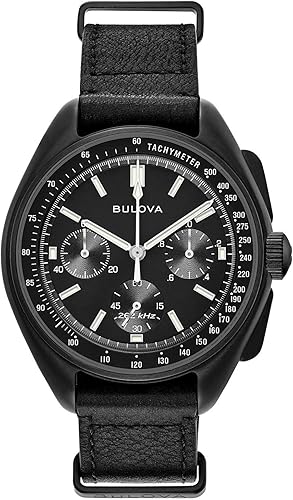
Bulova Archive Series Lunar Pilot Precisionist Chronograph
Bulova
- Precisionist movement, named in the title; the listing's battery field confirms it runs on a cell rather than a spring
- Sapphire crystal and a black NATO strap, both stated in the title
- Black ion-plated stainless steel case
- Reference 98A186 - part of Bulova's Archive Series
- 4.7 stars from 345 ratings
Why we picked it: Bulova presents the Archive Series as a revival of designs from its own back catalogue, and ties the Lunar Pilot line to the Apollo programme. That framing is the brand's rather than ours, and it is a large part of why the watch exists as a product - treat it as marketing history you may or may not care about. What the listing itself states is narrower and more useful: Precisionist, sapphire crystal, black ion-plated stainless steel, a black NATO strap, reference 98A186, and a lithium cell, which tells you it is quartz. Bulova describes Precisionist as its high-accuracy quartz movement; that claim is theirs, not something the listing substantiates. It is the most expensive pick here and the one with the most character.
Comparison Table
| Pick | Movement | Crystal | Water resistance | Ratings | Link |
|---|---|---|---|---|---|
| Best Overall | Eco-Drive (light-powered) | Sapphire, stated | Not stated in the title | 4.7 stars / 2,760 | See price |
| Best Value | Eco-Drive (light-powered) | Not stated | 200 m, stated | 4.8 stars / 360 | See price |
| Best Premium | Bulova Precisionist quartz | Sapphire, stated | Not stated in the title | 4.7 stars / 345 | See price |
What to Look For
Sapphire crystal is the upgrade that matters most. Mineral glass scratches from ordinary contact - a doorframe, a desk edge, a car door. Sapphire is hard enough that most of what a watch meets in a day cannot mark it. Two of our three picks state sapphire in the listing title; the third states nothing, which is not the same as saying it has mineral glass but is worth one question before ordering.
Do not press the pushers underwater. On most chronographs the pushers are not sealed while being operated, so running the stopwatch while swimming can let water past - and a depth rating describes a closed, still watch rather than one being used as a timer in a pool. There is a real exception: a handful of purpose-built dive chronographs use sealed or magnetically actuated pushers designed to be operated submerged, and their makers say so explicitly. If yours does not say so, assume it is not one of them.
Light-powered quartz removes the maintenance argument. Both Citizen picks run on Eco-Drive, which converts light to power and stores it in a rechargeable cell rather than a disposable battery. The practical effect is that you never book an appointment to keep the watch running. That is a real advantage over a conventional quartz chronograph, and it is worth more than it sounds on a watch you wear occasionally rather than daily.
Check whether you are buying a chronograph or a watch with extra dials. Plenty of watches carry three sub-dials that do nothing but show the day, date, and a 24-hour indicator. A chronograph has pushers - usually at two and four o'clock - and a hand that starts and stops. If a listing shows sub-dials but no pushers, it is not a chronograph, whatever the title says.
Bottom Line: Which Should You Buy?
For the deepest track record: the Citizen Classic Corso Eco-Drive — 2,760 ratings, sapphire, no battery.
For water and value: the Citizen Thin Blue Line — 200 m rated, highest average here.
For character: the Bulova Lunar Pilot Precisionist — Precisionist quartz, sapphire, NATO strap.
Ready to buy?
Jump straight to our picks on Amazon — current prices shown at click-through.
Frequently Asked Questions
What is the difference between a chronograph and a chronometer?
They are unrelated despite sounding similar. A chronograph is a stopwatch function - pushers, a running seconds hand, sub-dials counting elapsed time. A chronometer is a claim about accuracy, in the strict sense a movement certified to a defined standard. A watch can be one, both, or neither, and the words are frequently confused in marketing copy.
Are quartz chronographs worth buying?
For most people, yes. A quartz chronograph is more accurate, cheaper, thinner, and far less demanding than a mechanical one, and the stopwatch actually works reliably. Mechanical chronographs are the more interesting objects and cost several times more. All three picks in this guide are quartz, two of them light-powered.
What does Eco-Drive mean?
It is Citizen's light-powered technology: a cell under the dial converts light - daylight or indoor - into electricity and stores it in a rechargeable cell. There is no routine battery replacement, though the rechargeable cell is a consumable that a service centre eventually replaces, typically after well over a decade. Citizen states that a full charge keeps a watch running for more than six months in the dark, so one left in a drawer does not stop.
How do you use a chronograph?
The top pusher, usually at two o'clock, starts and stops the timing. The lower pusher, usually at four o'clock, resets everything to zero. The large central seconds hand counts the seconds being timed, and the sub-dials count elapsed minutes and hours. Reset before starting a new measurement rather than stopping and restarting.
Can you wear a chronograph swimming?
It depends entirely on the water resistance rating, and only one of our three listing titles states one - 200 metres, which is genuinely suitable for swimming. The other two titles are silent on it, which is not the same as saying they are not rated, so ask before assuming. The general rule regardless of rating is not to operate the pushers while submerged, unless the watch is specifically built for it.
Do chronograph watches need servicing?
Quartz chronographs need very little - a battery in a conventional one, and in a light-powered Eco-Drive only eventual gasket and rechargeable-cell replacement over many years. Water-resistant watches should be pressure-tested when opened either way. Mechanical chronographs are the opposite: they carry among the most complex movements in ordinary watchmaking and service costs reflect it.
Related Guides


How We Research
Picks are based on manufacturer specifications, current Amazon availability, and patterns across verified ratings data, captured at the time of research. Ratings and stock change — confirm current details at the retailer before buying.
Wearing note: Leave the chronograph reset when you are not timing something. On a mechanical chronograph, running it continuously accelerates wear on the movement; on any chronograph, a stopped hand parked mid-dial makes the watch harder to read at a glance. It is a stopwatch, not a second seconds hand.